Nightline recently aired an investigation on how you can buy a child fairly easily in Haiti. Here is the transcript from the show. Click for Nightline's page, which also has the original video, more clips and more photos. Please read. This is real. This is really happening. Don't think that this can't or doesn't happen here in America. After all, these Haitians shown in the video appear very comfortable dealing with Americans wanting to buy children as slaves. This story sickens me to my very core, thinking this is where my precious girls still are (thank God they are safe from the trafficking!!!).One Reporter's Journey Reveals An Epidemic of Child Slavery in Haiti
By DAN HARRIS
July 8, 2008
This deeply unsettling experiment starts on a typical Monday morning on Manhattan's leafy Upper West Side, where commuters stroll by Starbucks and Central Park.
Is it really possible to purchase a child in less than 10 hours?
At 7:10 a.m., I'm off to see how long it takes to buy a child slave.
It's 45 minutes to Kennedy Airport and an hour or so wait in the terminal, then a 3½-hour flight to Port-au-Prince, Haiti.
A band greets the flight.
By the time my team and I have collected our luggage, gone through immigration and customs, and are loaded into our vehicles, it's about 3:15 p.m.
As we leave the airport, two things become immediately apparent: Port-au-Prince is an amazing, vivid place, and it's also extremely poor. The U.S. State Department warns Americans against visiting here. United Nations peacekeepers patrol the roads while we drive with our own security team: two armed Haitian men in SUVs.
'I Would Like to Get a Child'
By 4:45 p.m., I'm poolside at one of the city's few upscale hotels. I'm wearing a hidden camera built into the strap of a bike messenger-style bag that's around my neck. There's another hidden camera in a leather satchel on the table, right next to the fruit plate and Evian water. My colleagues are manning cameras in hotel rooms overlooking the pool.
Our security guards are sitting discretely nearby.
That's when the man with whom I've arranged a meeting shows up.
He says he's a former member of parliament and that he has connections. In broad daylight, with hotel waiters walking by, he doesn't even flinch when I make a horrific request.
"If I would like to get a child to live with me and take care of me," I ask. "Could you do that?"
"Yes," he says. "I can."
He's speaking in Creole, the most prevalent Haitian language. The man doing the translation, who has set up the meeting, works for us (unbeknownst to the slave trafficker).
The trafficker assures me he's done this sort of transaction many times before.
"A girl or a boy?" he asks.
"A girl probably," I say.
"How old?"
"Maybe 10 or 11."
"Not a problem."
He says he can get me an 11-year-old girl, although he suggests that a 15-year-old might be better, because she'd be more "developed."
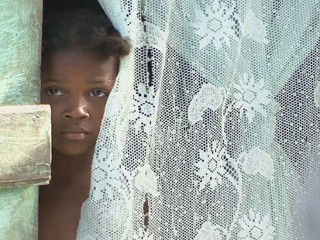
Onise, 8, was given away to a family that was slightly less poor than her own. She was promised an education but instead works as a laborer in her new home.
(ABC News)
I'm thinking: I can't believe I'm having this conversation.
"And this is OK?" I ask. "I won't have any trouble from their parents or anything like that?"
"No, you won't have any problems with their parents."
"Why not?"
"When I give you the child, I will train it for you."
I'm not exactly sure what that means.
A Successful Negotiation
"I'm a little nervous." I say. "I just want to make sure that this is OK, that I'm not going to get in trouble, that this will be smooth, that you've done this before."
"I guarantee my service," says the trafficker, grinning. "I can get you your girl as early as tomorrow."
And now, the negotiation begins.
"So how much will it cost me to get a child?" I ask.
"The last one I gave was $300."
Trying to test the value of human life, I push a little.
"I have a friend who got one for $50."
"No," he says.
"What about $100?"
"$150," he offers.
I accept.
And there it is. It's about 5 p.m. Roughly 10 hours after leaving my office in New York City, I have successfully negotiated to buy another human being -- an 11-year-old girl, whose value is set at just $150.
As we conclude our meeting, I want to make sure the trafficker does not act on my request. I ask him to wait a day before doing anything. I assure him I'll call him tomorrow with my final answer. He agrees.
Offering Fake Papers and a 'Pretty' Child
And then, to show that this grotesque sort of deal-making is not a fluke, I have a second meeting, with another trafficker -- a beefy guy with the air of a street thug.
This second trafficker is asking a much steeper price for an 11-year-old girl: $10,000.
"It's something definitive," explains our translator. "After the sale, he doesn't mind what happens to the kid."
"So for $10,000, I can have the child and do anything I want to do is what he's saying?" I ask.
"Yeah, definitely."
As further enticement, the trafficker says he can even get me fake papers that would allow me to take this child back to the U.S. with me. Both traffickers say they have experience providing children to Americans. According to the U.S. Department of Justice, officials have no idea how often this sort of transaction transpires. As the slightly menacing slave trafficker describes this girl he's promising to provide, I hear him use the French word "belle." French, along with Creole, is one of Haiti's official languages.
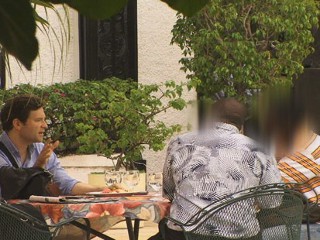
ABC News correspondent Dan Harris negotiates with slave dealers in Haiti.
(ABC News)
"Did he use the word 'belle'? Like, pretty girl?" I ask the translator.
"Yeah."
"So he's saying this would be a pretty child?"
"Yeah."
"Do you think he's hinting that the child would be a partner of some sort?"
"Yeah, it's up to you because that kid is yours."
Once again, I can't believe I'm having this conversation -- sitting in the sunshine so casually transacting such diabolical business. Just to make sure I fully understand the offer on the table, I ask, "If I pay $10,000 I essentially own this child?"
"Yeah, it's yours. You do whatever you want."
I've heard enough. I conclude the meeting, once again making sure the trafficker doesn't actually act on my request.
But now comes the craziest part of this wildly disturbing day.
Two waiters sitting nearby call me over. They say they've heard my conversations. At first I think they're going to yell at me or something. I'm bracing for shame. Instead, the waiters offer to sell me a child.
"So you're saying if I want to get a child to live with me, you can help me?" I ask. "Yes," says one of the waiters. "I give you my telephone also."
"About what age?" asks the other watier.
"Maybe 10, 11 years old."
"10 or 11?"
"Yeah," I say. "A girl."
"Ok," says the first waiter, rubbing his chin thoughtfully. "Ok. I'll help you."
The 'Restaveks'
Having illustrated how horrendously easy it is to buy a child slave in Haiti, let's consider something exponentially more awful: the real scandal here in Haiti is that children are usually just given away.
There are an estimated 300,000 child slaves in Haiti according to UNICEF. This staggering statistic is discussed in E. Benjamin Skinner's "A Crime So Monstrous," a new book about the enormous and often underreported problem of modern day slavery. Skinner has come to Haiti with us. He was the one who gave us the idea to see how long it would take to leave New York City and buy a child slave.
They're called "restaveks" -- a Creole term that means "stay-with." But these children often do more than just "stay with" families; they are usually forced to work from dawn until dusk, and are often underfed, beaten and sexually abused.
To meet some of these restaveks, my team and I traveled into the claustrophobic back alleys of one of Haiti's worst slums, Solino.
Here we find Onise, an achingly beautiful 8-year-old with haunted eyes. Her parents, who live in the countryside, are so poor they simply gave Onise away to a slightly less poor family in Port-au-Prince.
Her owners promised her parents they would pay for Onise's education. But every day, when the other children in the tiny, one-room hovel where the owners live head off to school, Onise stays behind to do housework and run errands.
When we get her alone, she reluctantly tells us about her life.
"When was the last time you talked to your parents?" I ask.
"No," she says. Our translator expands: "She never talks to them."
"Do you miss your parents?"
"Yes," she says, in a nearly inaudible voice.
This child seems dead inside. The insides of her forearms are covered in scars.
"Do they hit you a lot?"
"Yes," she says.
"When you dream, when you think about the things you want to do with your life -- your hopes -- what do you think about?"
"I want to drive a car," she says.
The Promise of School
It is a bleak irony that Haiti is crawling with child slaves. This, after all, is the only nation in modern history to be founded as the result of a slave revolt, in 1804.
It's also a place where parents clearly take great pride in their children's appearance, dolling them up in elaborate school uniforms every weekday morning. Parents here also make massive economic sacrifices to send kids to school, in this country where, for the most part, there are no public schools.
Slave traffickers use Haiti's poverty and lack of opportunity to their advantage.
"They dangle like a diamond necklace the promise of school," says Skinner. As he explains, Haiti's system of child slavery began generations ago. Poor families from the countryside would give their children to wealthy families in the city. The children would do domestic work, but they would also be fed, clothed and educated. It was a sort of social compact.
Even though the system has now morphed into something grotesque, traffickers exploit the false, residual glow of altruism.
"You talk to the traffickers about this," says Skinner, "and they'll often say, 'Well, I'm doing a service to the family that's giving up this child.'"
This bogus sheen of charity is perhaps why we are able to get slave owners to talk to us on camera. (Perhaps it's also because having a slave is so commonplace as to be almost entirely uncontroversial here.)
We meet Onita Aristide in a shantytown precariously perched over a ravine filled with trash and also wild pigs and goats. Aristide is a mother of two who sells sandals in the local market. For four months she's owned a "restavek" nicknamed Ti Soeur (Creole for "little sister.") As usual, Ti Soeur comes from a poor family in the country and spends her days here in the city doing forced labor. She sleeps on the floor of Onita Aristide's tiny home.
"Do you think she has a better life with you than she would have with her parents?" I ask Aristide.
"Yes," she says.
"Why?"
"Because her family is poor and cannot afford to support her."
There are a bunch of hard questions I want to ask this woman, for example, why doesn't she send the girl to school? But the scars on Ti Soeur's arms suggest I should tread lightly.
Knowing Aristide doesn't speak any English, I broach the topic with our translator. "I don't want to push her so hard that she gets angry and takes it out on the kid. Do you think I'm correct?"
"You're correct," he says.
Ti Souer's Hope
We follow Ti Soeur as she goes to fetch water from the communal well. This gives us a chance to ask her questions without her owners hearing.
She's a bright-eyed 11-year-old with short hair. When I ask her questions about the marks on her arm, she says, "The lady did it to me with an electric wire."
As I later learn, this appears to be a standard punishment -- whipping restaveks with the sort of electric cord you might you use to plug in a toaster or a laptop.
"Why would she do that to you?" I ask.
"Because one of the kids in the neighborhood came to see [her] in the house," the translator says.
"So you're not allowed to have any friends?"
"No."
"Do you have any time during the day where you can play, like a normal kid?"
"No. We don't play."
The translator explains, "If she doesn't go and pick up the water, they beat her up. If she doesn't sweep, beat her up."
By the time we visit Ti Soeur at 10 a.m., she's already cooked, cleaned, prepared the family children for school.
"Do you think the situation you're in right now is unfair?" I ask.
"Yes."
"Do you think you'll ever get out of this situation?"
"Yes."
"Do you have hope?"
"Yes."
"Good," I say.
After meeting Ti Souer, we decided to go find her parents, to get a sense of why they would give their child away.
'My Husband Forced Me'
Following a lead, we drive out of the throbbing, chaotic city, hours away, into the lush countryside. It's beautiful out here. We see clouds resting lazily in green valleys. We see women on their way to market, carrying impossibly large loads of goods on their heads.
But you can't miss the deprivation: It's everywhere. Haiti is the poorest country in the Western Hemisphere -- the result of decades of bad, brutal, kleptocratic leadership, and also, many believe, negative interference from outside powers, including the United States.
Haiti's poverty is on full display as we pull up to the house where Ti Soeur's mother lives. It's a shack, housing three families. Nine children live here, including one who we see using a condom as a toy balloon.
Ti Soeur's mother is named Lita Bellevue. After a few pleasantries, I ask her the obvious question.
"Can you tell me how it happened that you gave your daughter up?"
"My husband forced me to do it," she says.
She tells us that Ti Soeur's birth father is dead. Her new husband, who is abusive, forced her to give the child away, she says, because they are too poor to take care of her. However, the husband does not seem willing to part with the two young children he and Lita have had together.
"Can you imagine living without these children?" I ask.
"I cannot live without them," he says, flashing a nervous, toothless grin.
Lita says she's heard rumors that Ti Soeur is being abused by her owners.
"I hear she's being cut all over her arms and her head," she says. "I try very hard to rescue the child, to go see the child, but my husband won't let me."
"When you think about you daughter living this way, how hard is it for you?"
"I feel sick inside," she says.
To help us better understand why parents make these sorts of decisions, we go see Jean-Etienne Charles, a local Pentecostal pastor who preaches against child slavery. He's got a broad, happy face and a thriving church, complete with a school for local kids.
"I do not think that it is because they do not love the child," says Charles of parents who send their kids into servitude. "They love the kids; they love them. But because they think that they cannot take care of them, they turn them to another person."
As a sign of how deeply entrenched this practice is, it turns out that the pastor's family has a girl living with them whom they took on to do domestic work. They have since legally adopted her and are putting her through school, as an example to the families who abuse child slaves.
"I believe that people who do that should be thrown into jail," says Charles. "But the government is not doing anything about it, so that is why the Haitians are doing it."
Now that we've learned that Ti Soeur is stuck between slavery and an abusive, unhappy home, we decide to try our luck with the Haitian government. We go to the Department of Social Services and meet with several senior officials. We show them videotape of Ti Soeur's scars.
"This is unacceptable," says one official. She promises to act as early as possible. We leave feeling confident that Ti Soeur's fate may soon change.
But within days, government officials stop returning our phone calls, and Ti Soeur's case takes some surprising turns.
A Wrenching Scene
We learn that Bellevue, Ti Soeur's mother, has done something brave and extraordinary: she has forced her abusive husband to go and retrieve Ti Soeur from slavery.
With the government seemingly missing in action, we hook up with a social services organization affiliated with the American-based group Beyond Borders.
They work with mother and daughter, reunited as a result of Bellevue's courageous insistence, to get Ti Soeur accepted into a clean, cheerful orphanage.
But it's a mixed blessing for the former child slave.
Her mother is being kicked out of her house, for the crime of having spoken out to her husband. Rather than take Ti Soeur with her into an uncertain, and potentially homeless future, she decided to leave her at the orphanage, where she's safe.
As they're forced to part again, it's a wrenching scene. Ti Soeur is sobbing. She throws herself on the ground, inconsolable.
As we leave her, Ti Soeur seems traumatized, confused and lonely. But she's also, finally, in a place where she'll be fed, educated, safe and free from slavery.
For Haiti's child slaves, this may be as close to a happy ending as you'll find.